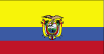
| Location | Western South America, bordering the Pacific Ocean at the Equator, between Colombia and Peru |
| Geographic coordinates | 2 00 S, 77 30 W |
| Map references | South America |
| Area | total: 283,561 sq km land: 276,841 sq km water: 6,720 sq km note: includes Galapagos Islands |
| Area - comparative | slightly smaller than Nevada |
| Land boundaries | total: 2,237 km border countries (2): Colombia 708 km, Peru 1529 km |
| Coastline | 2,237 km |
| Maritime claims | territorial sea: 12 nm exclusive economic zone: 200 nm continental shelf: 200 nm note: Ecuador has declared its right to extend its continental shelf to 350 nm measured from the baselines of the Galapagos Archipelago |
| Climate | tropical along coast, becoming cooler inland at higher elevations; tropical in Amazonian jungle lowlands |
| Terrain | coastal plain (costa), inter-Andean central highlands (sierra), and flat to rolling eastern jungle (oriente) |
| Elevation extremes | highest point: Chimborazo 6,267 lowest point: Pacific Ocean 0 m mean elevation: 1,117 m note: because the earth is not a perfect sphere and has an equatorial bulge, the highest point on the planet farthest from its center is Mount Chimborazo not Mount Everest, which is merely the highest peak above sea level |
| Natural resources | petroleum, fish, timber, hydropower |
| Land use | agricultural land: 29.7% (2018 est.) arable land: 4.7% (2018 est.) permanent crops: 5.6% (2018 est.) permanent pasture: 19.4% (2018 est.) forest: 38.9% (2018 est.) other: 31.4% (2018 est.) |
| Irrigated land | 15,000 sq km (2012) |
| Total renewable water resources | 442.4 billion cubic meters (2017 est.) |
| Natural hazards | frequent earthquakes; landslides; volcanic activity; floods; periodic droughts volcanism: volcanic activity concentrated along the Andes Mountains; Sangay (5,230 m), which erupted in 2010, is mainland Ecuador's most active volcano; other historically active volcanoes in the Andes include Antisana, Cayambe, Chacana, Cotopaxi, Guagua Pichincha, Reventador, Sumaco, and Tungurahua; Fernandina (1,476 m), a shield volcano that last erupted in 2009, is the most active of the many Galapagos volcanoes; other historically active Galapagos volcanoes include Wolf, Sierra Negra, Cerro Azul, Pinta, Marchena, and Santiago |
| Geography - note | note 1: Cotopaxi in Andes is highest active volcano in world note 2: genetic research indicates that the cherry-sized tomato originated in Ecuador without any human domestication; later domestication in Mexico transformed the plant into the large modern tomato; archeological research indicates that the cacao tree, whose seeds are used to make chocolate and which was long thought to have originated in Mesoamerica, was first domesticated in the upper Amazon region of northwest South America - present-day Ecuador - about 3,300 B.C. |
Source: CIA World Factbook
This page was last updated on September 18, 2021