| Country name | conventional long form: State of Eritrea conventional short form: Eritrea local long form: Hagere Ertra local short form: Ertra former: Eritrea Autonomous Region in Ethiopia etymology: the country name derives from the ancient Greek appellation "Erythra Thalassa" meaning Red Sea, which is the major water body bordering the country |
| Government type | presidential republic |
| Capital | name: Asmara geographic coordinates: 15 20 N, 38 56 E time difference: UTC+3 (8 hours ahead of Washington, DC, during Standard Time) etymology: the name means "they [women] made them unite," which according to Tigrinya oral tradition refers to the women of the four clans in the Asmara area who persuaded their menfolk to unite and defeat their common enemy; the name has also been translated as "live in peace" |
| Administrative divisions | 6 regions (zobatat, singular - zoba); Anseba, Debub (South), Debubawi K'eyih Bahri (Southern Red Sea), Gash Barka, Ma'akel (Central), Semenawi K'eyih Bahri (Northern Red Sea) |
| Independence | 24 May 1993 (from Ethiopia) |
| National holiday | Independence Day, 24 May (1991) |
| Constitution | history: ratified by the Constituent Assembly 23 May 1997 (not fully implemented) amendments: proposed by the president of Eritrea or by assent of at least one half of the National Assembly membership; passage requires at least an initial three-quarters majority vote by the Assembly and, after one year, final passage by at least four-fifths majority vote by the Assembly |
| Legal system | mixed legal system of civil, customary, and Islamic religious law |
| International law organization participation | has not submitted an ICJ jurisdiction declaration; non-party state to the ICCt |
| Citizenship | citizenship by birth: no citizenship by descent only: at least one parent must be a citizen of Eritrea dual citizenship recognized: no residency requirement for naturalization: 20 years |
| Suffrage | 18 years of age; universal |
| Executive branch | chief of state: President ISAIAS Afwerki (since 8 June 1993); note - the president is both chief of state and head of government and is head of the State Council and National Assembly head of government: President ISAIAS Afwerki (since 8 June 1993) cabinet: State Council appointed by the president elections/appointments: president indirectly elected by the National Assembly for a 5-year term (eligible for a second term); the only election was held on 8 June 1993, following independence from Ethiopia (next election postponed indefinitely) election results: ISAIAS Afwerki elected president by the transitional National Assembly; percent of National Assembly vote - ISAIAS Afwerki (PFDJ) 95%, other 5% |
| Legislative branch | description: unicameral National Assembly (Hagerawi Baito) (150 seats; 75 members indirectly elected by the ruling party and 75 directly elected by simple majority vote; members serve 5-year terms) elections: in May 1997, following the adoption of the new constitution, 75 members of the PFDJ Central Committee (the old Central Committee of the EPLF), 60 members of the 527-member Constituent Assembly, which had been established in 1997 to discuss and ratify the new constitution, and 15 representatives of Eritreans living abroad were formed into a Transitional National Assembly to serve as the country's legislative body until countrywide elections to form a National Assembly were held; although only 75 of 150 members of the Transitional National Assembly were elected, the constitution stipulates that once past the transition stage, all members of the National Assembly will be elected by secret ballot of all eligible voters; National Assembly elections scheduled for December 2001 were postponed indefinitely due to the war with Ethiopia, and as of late 2020, there was no sitting legislative body election results: NA |
| Judicial branch | highest courts: High Court (consists of 20 judges and organized into civil, commercial, criminal, labor, administrative, and customary sections) judge selection and term of office: High Court judges appointed by the president subordinate courts: regional/zonal courts; community courts; special courts; sharia courts (for issues dealing with Muslim marriage, inheritance, and family); military courts |
| Political parties and leaders | People's Front for Democracy and Justice or PFDJ [ISAIAS Afwerki] (the only party recognized by the government) |
| International organization participation | ACP, AfDB, AU, COMESA, FAO, G-77, IAEA, IBRD, ICAO, ICC (NGOs), IDA, IFAD, IFC, IFRCS (observer), ILO, IMF, IMO, Interpol, IOC, ISO (correspondent), ITU, ITUC (NGOs), LAS (observer), MIGA, NAM, OPCW, PCA, UN, UNCTAD, UNESCO, UNIDO, UNWTO, UPU, WCO, WFTU (NGOs), WHO, WIPO, WMO |
| Diplomatic representation in the US | chief of mission: Ambassador (vacant); Charge d'Affaires BERHANE Gebrehiwet Solomon (since 15 March 2011) chancery: 1708 New Hampshire Avenue NW, Washington, DC 20009 telephone: [1] (202) 319-1991 FAX: [1] (202) 319-1304 email address and website: embassyeritrea@embassyeritrea.org https://us.embassyeritrea.org/ |
| Diplomatic representation from the US | chief of mission: Ambassador (vacant); Charge d'Affaires Steven C. WALKER (since December 2019) embassy: 179 Alaa Street, Asmara mailing address: 7170 Asmara Place, Washington DC 20521-7170 telephone: [291] (1) 12-00-04 FAX: [291] (1) 12-75-84 email address and website: consularasmara@state.gov https://er.usembassy.gov/ |
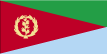
| Flag description | red isosceles triangle (based on the hoist side) dividing the flag into two right triangles; the upper triangle is green, the lower one is blue; a gold wreath encircling a gold olive branch is centered on the hoist side of the red triangle; green stands for the country's agriculture economy, red signifies the blood shed in the fight for freedom, and blue symbolizes the bounty of the sea; the wreath-olive branch symbol is similar to that on the first flag of Eritrea from 1952; the shape of the red triangle broadly mimics the shape of the country note: one of several flags where a prominent component of the design reflects the shape of the country; other such flags are those of Bosnia and Herzegovina, Brazil, and Vanuatu |
| National symbol(s) | camel; national colors: green, red, blue |
| National anthem | name: "Ertra, Ertra, Ertra" (Eritrea, Eritrea, Eritrea) lyrics/music: SOLOMON Tsehaye Beraki/Isaac Abraham MEHAREZGI and ARON Tekle Tesfatsion note: adopted 1993; upon independence from Ethiopia |
Source: CIA World Factbook
This page was last updated on September 18, 2021